
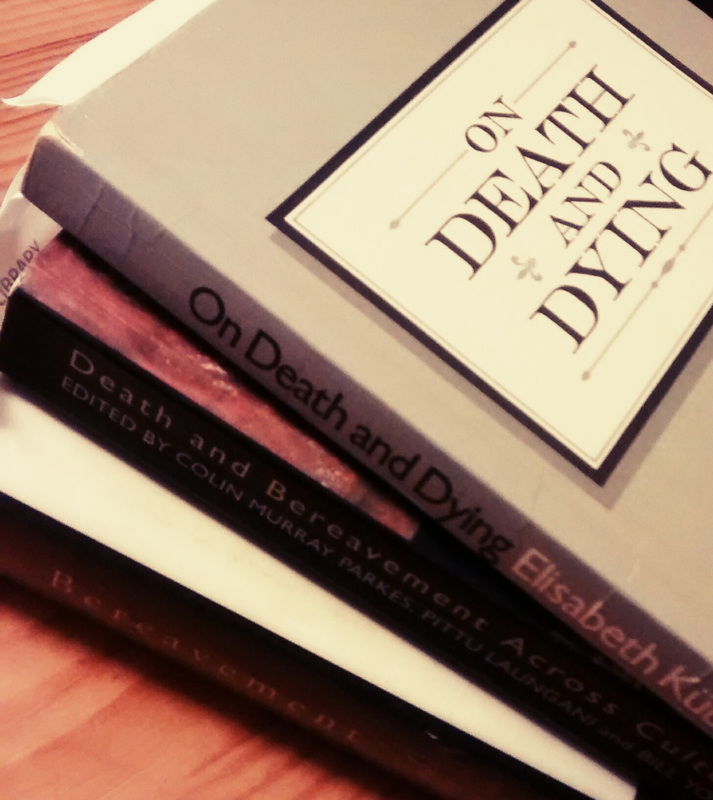
Cheerful reading before bedtime.
I've been critical of Kübler-Ross's grief stages mostly because it's been detrimental to my recovery from the loss of my parents. I didn't really pay much attention to the stages personally, but those around me expected me to follow this strict guide of when and how to feel. I know this is a gross misapplication of the grief model, but the misapplication is societal. In both deaths, when I wasn't following the prescripted stages I was questioned and bullied over it. What this ended up causing was for me to retreat further within, thinking I was experiencing death the wrong way. Eventually I just shut it out entirely and it festered like an infected wound for years while I consciously tried to bury it deeper. My whole issue comes from the way grief models are presented. They're usually listed, and even with warnings ("please don't use this as a list!"), we still do. Perhaps if the model was some sort of visual graphic it could better represent the seemingly universal moods that we can all connect with. I don't doubt there isn't a fair set of emotions we all may feel, but we all experience bereavement so radically differently I fear even suggesting, say "anger" (one I haven't personally encountered) as an emotion present in grief will present a problem for people who haven't felt it.
Lauren J. Breen and Moira O’Connor[1] note the fundamental structure of grief through psychology analysis also fails to consider grief doesn’t always align to specific functions. They posit that this creates a paradox for complicated grief: a cyclic interference in what may actually be healthy grieving following a delineated path. By medicalising grief, and assigning a diagnostic category, we create a self-fulfilling prophesy of damaged individuals. This does not, in fact, prove that complicated grief isn’t a thing, rather, it proves its existence by default. Until a society can understand death, we will not have the correct capacity to deal with it.
[1] Breen, L. J. & O’Connor, M. (2007) “The fundamental paradox in the grief literature: a critical reflection.” Omega: journal of death and dying. 55 (3) 199-218.
I've been critical of Kübler-Ross's grief stages mostly because it's been detrimental to my recovery from the loss of my parents. I didn't really pay much attention to the stages personally, but those around me expected me to follow this strict guide of when and how to feel. I know this is a gross misapplication of the grief model, but the misapplication is societal. In both deaths, when I wasn't following the prescripted stages I was questioned and bullied over it. What this ended up causing was for me to retreat further within, thinking I was experiencing death the wrong way. Eventually I just shut it out entirely and it festered like an infected wound for years while I consciously tried to bury it deeper. My whole issue comes from the way grief models are presented. They're usually listed, and even with warnings ("please don't use this as a list!"), we still do. Perhaps if the model was some sort of visual graphic it could better represent the seemingly universal moods that we can all connect with. I don't doubt there isn't a fair set of emotions we all may feel, but we all experience bereavement so radically differently I fear even suggesting, say "anger" (one I haven't personally encountered) as an emotion present in grief will present a problem for people who haven't felt it.
Lauren J. Breen and Moira O’Connor[1] note the fundamental structure of grief through psychology analysis also fails to consider grief doesn’t always align to specific functions. They posit that this creates a paradox for complicated grief: a cyclic interference in what may actually be healthy grieving following a delineated path. By medicalising grief, and assigning a diagnostic category, we create a self-fulfilling prophesy of damaged individuals. This does not, in fact, prove that complicated grief isn’t a thing, rather, it proves its existence by default. Until a society can understand death, we will not have the correct capacity to deal with it.
[1] Breen, L. J. & O’Connor, M. (2007) “The fundamental paradox in the grief literature: a critical reflection.” Omega: journal of death and dying. 55 (3) 199-218.
 RSS Feed
